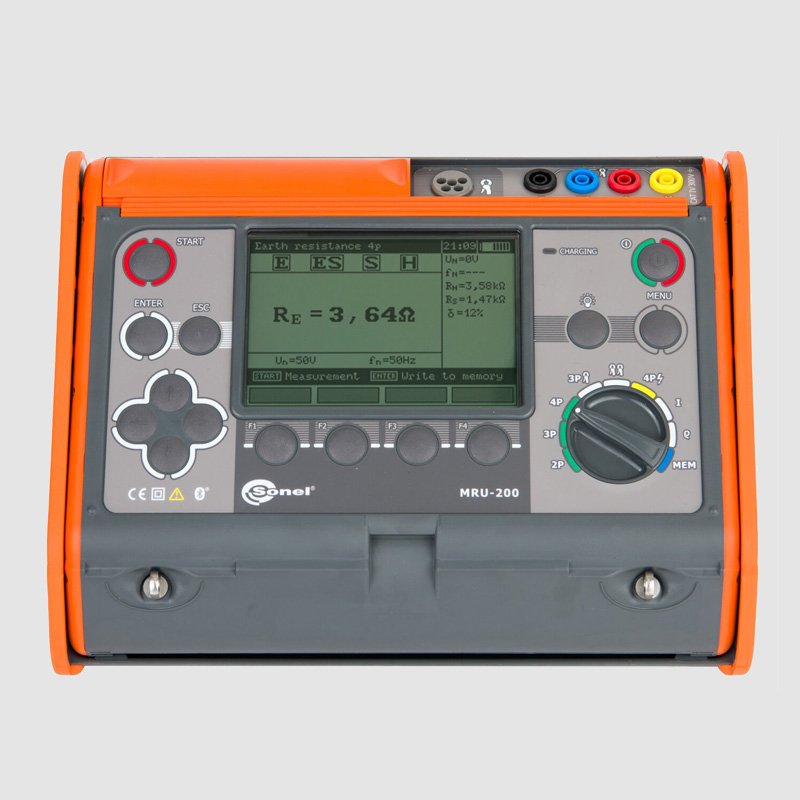
MRU-200 Earthing resistance and soil resistivity meter
Multifunctional measuring device for measuring earth resistance and specific earth resistance
The Sonel MRU-200 device for measuring earth resistance and specific earth resistance can be used for measurement using various methods.
What clearly distinguishes this model from other measuring devices of this type is the possibility of using all known methods of measuring earth resistance. Measurements can be taken using the technical 3-pole and 4-wire methods, with additional clamps (multiple earthing), with the two-clamp method and the impulse method (measurement of earthing impedance).
The use of the two-clamp method allows tests to be carried out without the need for additional auxiliary probes to be driven into the ground. The impulse method, on the other hand, is used, among other things, in the diagnosis of lightning protection earthing. It is also used to measure large-area, multiple and connected (including underground) earthing systems. The advantage of this method is that there is no need to intervene in the circuit. The impulse method also allows measurements to be taken in accordance with the EN 62305 standard, where earthing impedance must be taken into account.
But that’s not all the Sonel MRU-200 measuring device has to offer. The device also has the function of measuring the specific earth resistance, the continuity of the protective and equipotential bonding connections, and, when using clamps, also the leakage or fault current.
In addition to its wide range of functions and numerous measurement options, the MRU-200 measuring device also deserves recognition for the accuracy of its measurements. Measuring range: Measurements in accordance with standard EN 61557 – starting at just 0.100 Ω.
Measurement methods:
- Pulse method – Measurement of lightning protection systems using a measurement pulse with a pulse edge of 4/10 μs , 8/20 μs , 10/350 μs
- 3-pole and 4-wire method – earth resistance measurement with auxiliary probes
- 3-pole method with clamps – measurement of multiple earth connections
- Two-clamp method – earth resistance measurement when auxiliary probes cannot be used
- Specific earth resistance – Wenner method
- Resistance of earthing and equalizing conductors with a test current of ≥200 mA. Automatic grounding of the measuring leads – meets the requirements of EN 61557-4.
- Leakage current measurement
Additional features:
- Measurement of the resistance of the auxiliary probes R S i R H
- Measurement of interference voltages
- Frequency measurement of interference signals
- Measurement of interference voltages occurring under the influence of supply lines in power grids with frequencies of 16 2/3 Hz, 50 Hz, 60 Hz and 400 Hz
- Selection of the maximum measuring voltage (25 V and 50 V)
- When measuring specific earth resistance, the distances between the electrodes can be entered in meters (m) or feet ( ft ).
- Storage for 990 measurements (10 banks of 99 cells each)
- Calibration function for pliers
- Real-time clock (RTC)
- Data transfer to PCs and mobile devices
- Battery charge level indicator
Areas of application:
The MRU-200 measuring devices were developed for the most demanding working conditions . They generate a test current of over 200 mA, enabling effective measurement of the grounding of substations and power plants.
Using pliers eliminates the need to disconnect connections . This is particularly important when working on objects exposed to harsh weather conditions where the fasteners are corroded or rusted.
The graphical user interface displays clear results and unambiguous messages. This enables quick and effective use.
Impulse method:
The MRU-200-GPS can be used to test the grounding of lightning protection systems , as these measuring devices can simulate the conditions that occur during a lightning strike – they generate currents with a standardized pulse edge and a time to half peak. Available pulse durations are 4/10 μs , 8/20 μs , and 10/350 μs .
Compatibility with the ERP-1 adapter
The ERP-1 adapter allows the user to test grounding systems with flexible clamps. This is particularly useful, for example, on lattice towers – there is no need to disconnect the power or unplug control connectors. A proprietary algorithm allows the user to verify the current direction in each measurement and facilitates the detection of damage, such as corroded steel struts or straps.
Characteristics:
The measuring methods available in the device enable comprehensive monitoring of the working and protective earthing. The calibration function of the measuring leads eliminates the influence of their resistance on the result. But that's not all.
- The 4-wire method enables a very precise measurement of the very low expected resistance values. The measuring leads connected to the grounding system have no influence on the measurement result.
- Measuring the resistance of the earth connection and the equipotential bonding with a current of more than 200 mA meets the requirements of standard EN 61557-4.
- Before measuring, the measuring device checks whether excessive interference voltage is present , which may be an indication of further irregularities.
Storage and results:
The results can be stored in the device's memory. This is divided into 10 banks of 99 cells each , with each cell corresponding to one measurement. These results can be easily transferred to the Sonel Reader software for archiving or later analysis.
The Bluetooth interface can be used to transfer measurement results to PC software or to a mobile phone using the dedicated Sonel MRU Mobile app . This not only provides a data archiving function but also allows for further data transfer – directly on-site via email.